
The Roman orator and statesman Marcus Tullius Cicero once said, ‘By doubting we come to the truth.’ It is a line worth revisiting in an age shaped by misleading certainties and AI systems that hallucinate with absolute confidence. Doubt is no longer a flaw to suppress; it is a discipline worth practising.
When I was at school, there were no algorithms generating misinformation. We had teachers and parents for that. I was told things that, at the time, sounded certain, obvious even. Quite a few turned out to be wrong.
Cracking your knuckles causes arthritis. You use only ten percent of your brain. The Great Wall of China is the only man-made object visible from space. None of that is true.
I was taught that memory works like a video recorder, that left-brained people are logical and right-brained people are creative, and that blood is blue in your veins until it is exposed to oxygen. Those are wrong as well.
Oh, and goldfish do not have three-second memories. They can remember things for months.
Today, children move through an information stream that never really switches off. Conspiracy theories appear on feeds, “facts” travel as memes, and large language models produce fluent paragraphs built on pattern rather than proof.
We cannot always trust ourselves. Our memories are not fixed. Every time we recall an event, we reshape it slightly. Our thinking leans on shortcuts that favour speed and coherence over accuracy. AI has learned to imitate those shortcuts.
This brings us to something stranger: collective misremembering. Many people vividly “remember” Nelson Mandela dying in prison in the 1980s, when in fact he was released in 1990 and later became president. Our brains store related memories in networks, so lines blur. This is the Mandela Effect, and social media can help those false memories spread and settle.
Sometimes the brain goes further and adds details that never existed. This is confabulation. It is not deception; it is tidying. Given enough retellings, those additions harden, and the invented version feels real.
We also need to guard against priming. The way a question is phrased shapes what we think we know. ‘Did you see the black car?’ suggests it existed. ‘Did you see a car?’ keeps the memory open. A small change in wording can create a memory of something that never happened.
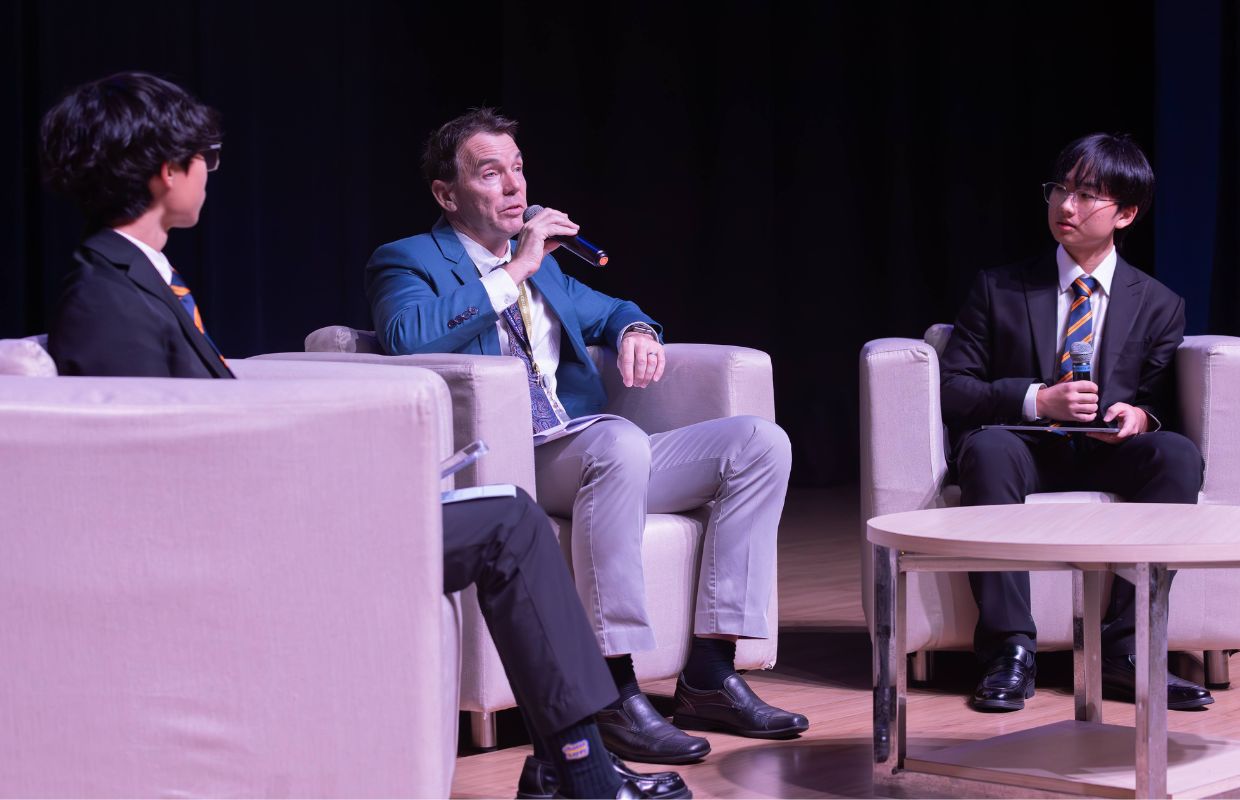
That is why it is crucial for us to help students slow their own thinking, question what feels obvious, and test their assumptions. In this talk, I draw on the work of Daniel Kahneman, Hans Rosling, and the older tradition of the Socratic method: not handing students answers, but showing them how to ask better questions.
For parents, the message is straightforward. Doubt is not cynicism. It is curiosity with standards. Encourage your children to pause before forwarding, posting, or accepting a neat explanation. Ask, ‘How do you know?’ Invite them to compare sources, to look for data, to change their minds in the light of new evidence. What will matter most is not how quickly they answer, but how carefully they think.
Dr Terence McAdams
Chief Education Officer